

Benefits of Small Batch Apparel: Quality, Sustainability & More
Table of Contents
- What Small-Batch Apparel Production Actually Means
- Small-Batch vs. Mass-Produced Clothing: The Core Differences
- Small-Batch Clothing Quality and Craftsmanship
- Small-Batch Clothing Sustainability and Environmental Impact
- Production Flexibility and Design Innovation
- Small-Batch Apparel Pricing: Understanding the Investment
- When Small-Batch Production May Not Be the Right Choice
- Frequently Asked Questions
Last Updated: October 12, 2026
What Small-Batch Apparel Production Actually Means
Small-batch apparel refers to clothing manufactured in limited quantities rather than mass production runs, hundreds or even dozens of garments per design instead of thousands of identical pieces, defining an intentional approach to production. At B Did It !!, this approach defines our philosophy: we limit production so every piece carries weight and meaning.
The core difference is intentionality. Mass production optimizes for volume and cost; small-batch production optimizes for quality, storytelling, and cultural authenticity. Making 50 units instead of 5,000 means every stitch and color choice reflects purpose.
This model shifts how design decisions get made. Rather than committing months in advance and hoping a design sells, small-batch production lets brands respond to feedback, test new directions, and honor cultural narratives without risking unsold inventory. Smaller runs also mean less capital tied up in excess stock and more flexibility to pivot when demand shifts.
| Aspect | Small-Batch Production | Mass Production |
|---|---|---|
| Typical Run Size | 50-500 units | 5,000+ units |
| Design Testing | Iterative, responsive | Locked in advance |
| Inventory Risk | Lower | High |
| Production Flexibility | High | Low |
| Lead Time | Shorter | Longer |
Small-Batch vs. Mass-Produced Clothing: The Core Differences
The distinction between small-batch and mass-produced clothing extends beyond numbers. Mass production bets everything on one outcome: factories are booked, fabric is ordered in massive quantities, and the design is locked. If the market doesn't respond, you're stuck with depreciating inventory.
Small-batch production inverts that risk: you test the market with limited runs, gather real feedback, and iterate. That flexibility lets brands honor cultural narratives instead of chasing trends, and lets designers experiment with bold graphics, unconventional silhouettes, and color combinations mass-market brands would never risk.
Production flexibility also affects how quickly new designs reach customers. Mass production requires 60-90 day lead times because factories need volume to justify setup costs. Small-batch runs let brands stay responsive to what their community wants rather than what was planned a quarter ago.
Quality control also works differently. At 100 pieces, every defect gets caught; at 10,000, some slip through and it's accepted as inevitable.
Small-Batch Clothing Quality and Craftsmanship
Quality control in small-batch production isn't a department, it's a practice embedded in every stage. Because runs are small, the people who cut the fabric often inspect the finished garments, continuity that creates accountability mass production can't replicate.
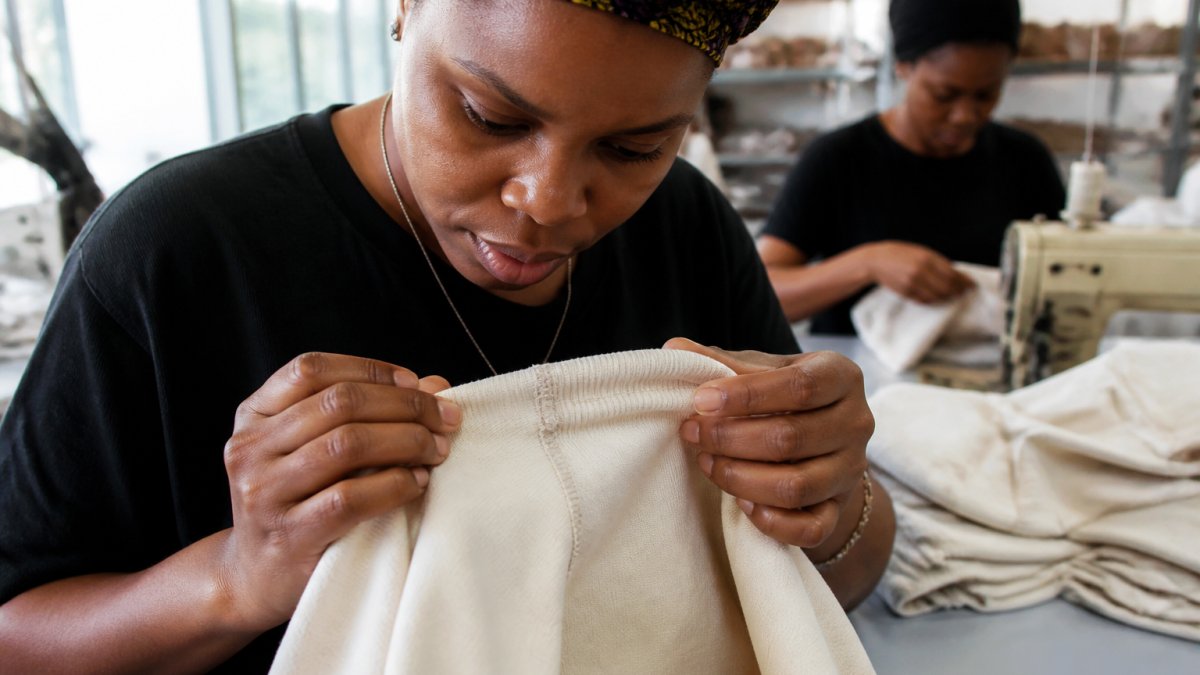
Craftsmanship shows up in the details: double-needle stitching on seams, reinforced collar construction, pre-shrunk fabric that won't disappoint after the first wash. These are deliberate choices that signal respect for the wearer. Our Definition Of Odogwu Unisex Garment-Dyed Drop-Shoulder T-Shirt exemplifies this: 100% USA cotton, assembled in the USA from globally sourced materials, with reinforced stitching throughout.

The garment-dye process reflects this commitment too. Garment-dyed pieces develop character: the color becomes richer, the fabric softens, and the piece tells the story of being worn and loved, aging with intention, not degrading.
Small-Batch Clothing Sustainability and Environmental Impact
The sustainability case for small-batch production is usually a slogan: less waste, less water, less energy. That's directionally true, but the useful version explains where the savings come from and how much they depend on brand decisions.
Start with the waste math. In conventional cut-and-sew production, fabric utilization typically runs 80-85% for simple garments and lower for complex patterns, meaning 15-20% of every yard becomes scrap before a single unit ships. Small-batch runs don't automatically fix that, a 50-unit run can waste just as much per unit if the marker is inefficient. What small batches change is the volume of scrap and, more importantly, the volume of finished goods that never sell. Industry estimates put unsold apparel inventory at 20-30% of production for mass-market brands; every unsold unit carries its full embedded footprint, fiber, dye, water, energy, freight, to a landfill or donation bale.
Water and energy scale with volume, but not perfectly linearly. Dyeing is the most water-intensive step in cotton apparel, and per-garment water use drops as batch size grows because dye baths are reused across more units, so a small-batch garment can carry a higher per-unit water footprint if the brand uses the same dyeing method. The environmental win comes from three places instead:
- Producing closer to demand. Fewer unsold units means the water and energy embedded in those units isn't wasted. A run that sells through at 90% has a far lower effective footprint per sold garment than a run that sells through at 60%.
- Shorter, more traceable supply chains. Smaller brands more often work with domestic or regional cut-and-sew shops, which cuts ocean freight and the associated emissions. A garment assembled within a few hundred miles of where it's sold avoids the roughly 10,000-12,000 nautical miles a typical Asia-to-U.S. container route adds.
- Material choices that compound. Organic or recycled cotton, lower-impact dyes, and garment-dyeing processes that use less water per unit than conventional piece-dyeing all reduce the baseline. Small batches make these premium inputs affordable to test, you can run 100 units in an organic cotton you couldn't justify ordering 10,000 yards of.
That conditionality is why transparency matters more than a vague eco-claim. A brand producing in runs of dozens to hundreds can name its mill, dye house, and cut-and-sew partner, and a customer can verify them. The practical test: can the brand tell you where the garment was made and who made it? If the answer is vague, the small-batch label isn't doing much environmental work.
EPA textile waste and materials management guidance
Production Flexibility and Design Innovation
Small-batch production unlocks design possibilities mass production forbids. Without massive production commitments, you can take risks: test silhouettes that might not work, honor cultural narratives that wouldn't appeal to a mainstream audience, and create limited-edition pieces that feel genuinely special rather than manufactured scarcity.
This flexibility extends to community feedback. If your audience wants a specific color, produce a small run to test demand. If a design resonates, reorder. If something doesn't land, cut your losses. That responsiveness creates a conversation between brand and customer rather than a one-way broadcast.
Innovation happens faster in small-batch environments because failure is cheaper. You can experiment with new fabric blends, printing techniques, or unconventional color combinations without betting the company.
The design iteration process improves too. Small-batch brands refine based on early feedback, market response, and cultural moments, designing closer to release, so work stays relevant rather than dated before it ships.
FGC PH 90set Altenative customizable T-Shirt →
Small-Batch Apparel Pricing: Understanding the Investment
Most articles about small batch apparel say it costs more per unit and leave it there. That's not useful if you're deciding whether to produce a run.
Here's the cost structure that drives small-batch pricing:
| Cost Component | Behavior in Small Runs | Behavior in Large Runs |
|---|---|---|
| Pattern making & grading | Fixed, same cost for 50 or 5,000 units | Fixed, spread thin |
| Sample development | Fixed, often 2-4 rounds | Fixed, spread thin |
| Fabric minimums | Often the binding constraint | Easily met |
| Cutting setup (marker, spread) | Fixed per run | Fixed per run |
| Sewing labor | Higher per unit, no line specialization | Lower per unit, assembly-line efficiency |
| Dyeing | Higher per unit, small dye baths | Lower per unit, large baths |
| Quality control | Higher per unit, 100% inspection feasible | Lower per unit, AQL sampling |
| Freight & duties | Higher per unit, no container consolidation | Lower per unit |
The pattern is consistent: fixed costs don't shrink with run size, so they get divided across fewer units.
Minimum order quantities (MOQs) are the practical gate. Fabric mills commonly set MOQs by the roll, often 50-100 yards per colorway for domestic mills, higher for imported goods.
Where the break-even sits. Per-unit cost typically falls steeply from 50 to 500 units, then flattens. Going from 50 to 200 units might cut per-unit cost by 30-40%; going from 500 to 2,000 might cut it another 10-15%.
What the price actually reflects. Take a garment-dyed, ring-spun cotton tee produced in a limited run. The price covers fixed development costs spread across few units, a fabric minimum that may exceed the run's needs, 100% inspection rather than sampling, and domestic or near-shore labor paid at viable rates. A mass-market equivalent at a third of the price is cheaper because those costs are divided across tens of thousands of units, and because some (inspection, traceable sourcing, fair labor rates) are reduced or removed.
How to evaluate whether the premium is worth it. Compare on cost-per-wear, not sticker price. The small-batch premium is justified when construction, fabric weight, and dye method actually extend useful life. If they don't, the premium is just branding.
For brands weighing the model, the practical questions are: What's my fabric MOQ per colorway? What's the smallest run my cut-and-sew partner will accept? At what unit count does per-unit cost flatten?
When Small-Batch Production May Not Be the Right Choice
Small-batch production isn't universally better. It's a different model optimized for different goals, with real limitations.
If you need apparel at the absolute lowest price point, mass production wins, economies of scale are real. If your priority is maximum availability and instant gratification, small-batch production can't compete: limited runs sell out, and reorders take weeks.
Small-batch production also requires different marketing. You can't rely on shelf space and passive browsing; you need an audience that actively seeks you out, understands your brand narrative, and accepts that pieces are limited. That takes community building and storytelling mass-market brands don't need.
There's also a learning curve. Customers accustomed to mass-market expectations struggle with small-batch realities: longer waits, occasional stockouts, higher prices. Managing those expectations requires clear communication and a brand philosophy customers genuinely believe in.
For brands prioritizing growth through volume and rapid scaling, small-batch production creates constraints. You can't suddenly produce 50,000 units to meet unexpected demand; growth is limited by production capacity, and expanding it requires significant investment and time.
Small-batch apparel represents a deliberate choice to prioritize quality, cultural authenticity, and sustainability over volume and convenience. We create apparel that serves as a powerful statement, honoring cultural roots through premium quality graphics and unique, purpose-driven drops. Register Here For VIP Access to stay updated on limited-edition releases and exclusive content that celebrates African excellence.
Frequently Asked Questions
What makes small batch apparel better quality than mass production?
Small-batch production allows manufacturers to focus on quality control at every stage. With fewer units per production run, each garment receives closer inspection, reducing defect rates. Craftspeople can catch issues with stitching, fabric consistency, and fit before items ship. Mass production prioritizes speed and volume, which often means quality checks are less thorough. Smaller production runs also mean less pressure to rush through manufacturing, allowing for better attention to fabric selection and construction details.
Is small-batch clothing more sustainable than mass-produced apparel?
Limited production runs mean less overproduction and textile waste. Brands can test demand more accurately, reducing the risk of unsold inventory ending up in landfills. However, sustainability depends on the manufacturer's practices, ethical sourcing and responsible production methods matter equally.
Why does small-batch apparel cost more than mass-produced clothing?
Small-batch apparel has higher per-unit costs because production expenses are spread across fewer items. Manufacturing setup, quality control, and labor represent fixed costs that become cheaper per garment at scale. Small-batch runs also often use higher-quality materials and allow for more detailed craftsmanship. There's less pressure to cut corners on fabric or construction. Additionally, limited-run designs command premium pricing because exclusivity has value, you're paying for access to designs and quality that won't be mass-produced and sold everywhere.
How can I tell if a small-batch brand is actually worth the premium price?
Look for transparency about production methods and material sourcing. Legitimate small-batch brands explain their manufacturing process, share information about lead times, and are honest about minimum order quantities. Check for consistent quality control, read customer reviews about durability and fit. Examine the garment details: double-needle stitching, fabric weight, and finish quality are signs of care. Brands like B Did It !! that emphasize limited drops and intentional design choices show commitment to quality over volume. Be wary of brands claiming exclusivity without backing it up with verifiable production limits or transparent reorder policies.